

Pan-seared tuna steaks with maple and mustard
- Preparation 25 min
- Cooking 2 min
- Servings 3 to 4
- Freezing Not recommended
Ads
🐟 The fish counter that rewrote my tuna
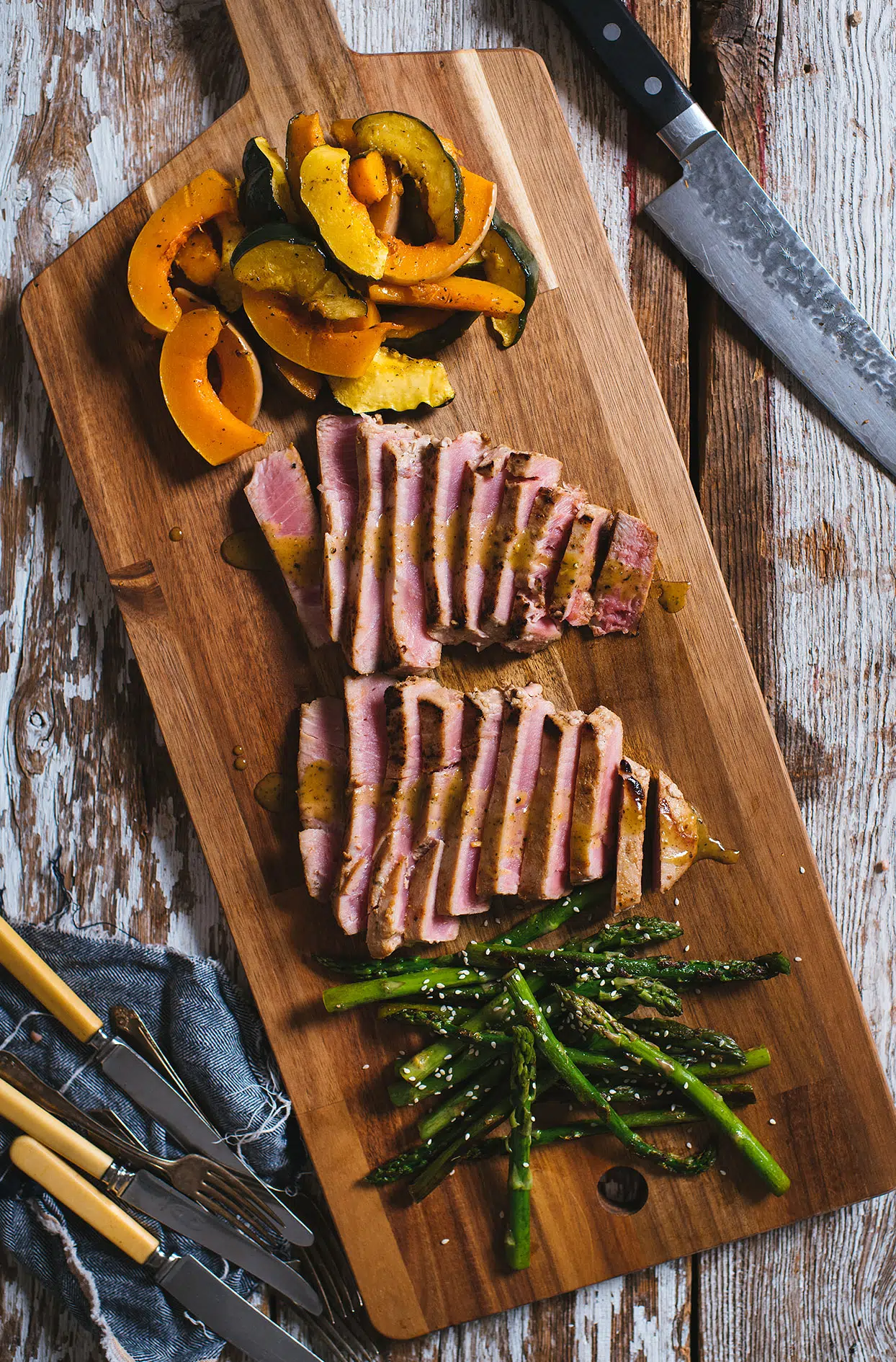
This one started with a local fish market that put sushi-grade tuna in my hands every single week. After a while you run out of patience for your own habits. Sesame tataki again. Soy and ginger again. I wanted the fish to taste like where I actually live, so I reached for the two things that go on pork and chicken in every Quebec kitchen: maple syrup and Dijon mustard. First try, I was done arguing. Caramelized outside, cool and rosé through the middle, sweet and sharp at the same time.
🍁 Why maple and Dijon beat soy and sesame here
Maple carries sugar that grabs colour almost instantly in a hot pan, and Dijon comes in behind it with that mustard bite that keeps the whole thing from turning into candy. Put them on a piece of tuna that only sees the pan for a minute and a half total, and you get a real contrast: a lacquered, slightly bitter crust sitting right up against flesh that is still cold. That gap is the whole dish. It is also the reason I stopped making the Asian versions.
⚡ Thirty minutes, and most of it is waiting
Prep to plate is about half an hour, and the searing part is ninety seconds. That ratio is why this ends up on my stove on a Tuesday as often as a Saturday. Three rules and nothing else: the tuna stays cold until it hits the pan, the pan runs medium-high instead of wide open, and nobody goes past 45 seconds a side. Follow those and it comes out the same every time, which is more than I can say for most fish.
Ads

Ads
🧊 Cold tuna. This is the whole game
Out of the fridge at the last second, straight into the marinade, straight into the pan. Tuna that has been sitting on the counter is already halfway cooked before it touches heat, and you lose the cool centre in about ten seconds. Everything else in this recipe is negotiable. This is not.
🐟 Sushi-grade, or make something else tonight
Ask the fish counter directly. In the United States you will usually see it sold as ahi, yellowfin or bluefin, and the label you want says sushi grade or sashimi grade. Regular case tuna will not work here, because a 90-second sear does nothing to hide a mediocre piece of fish: the middle reads metallic and the texture goes soft. You are buying two steaks. Buy the good ones. Frozen is fine too, as long as it was frozen at sea and you thaw it overnight in the fridge, never on the counter and never under running water.
🔥 Medium-high. Not wide open
Give the pan a splash of oil and about two minutes to come up. You want a heavy pan that actually holds its heat, and you want the oil shimmering and sliding, not smoking. Full blast sounds right and is wrong: the maple in the marinade burns before it caramelizes and you end up with a bitter crust on cold fish. Oil, not butter, for the sear. Butter has milk solids that scorch at this heat, and the tuna is out of the pan long before butter would give you anything back.
⏱️ Forty-five seconds a side, timer running
For a 250 g (9 oz) steak at 2 cm (3/4 in), that is 45 seconds and then it flips, and 45 seconds and then it comes out. Longer than that and the heat walks into the centre, which is where tuna turns dry and rubbery and there is no rescuing it. Thicker steak, closer to 3 cm (1 1/4 in), goes to about a minute a side. Thinner than 2 cm, go by colour instead of the clock and pull it the moment the seared band creeps past a few millimetres.
🌡️ Where the temperature should land
If you like numbers, an instant-read probe in the middle of a properly seared tuna steak will show somewhere around 46 to 52 °C (115 to 125 °F). That is rare, and it is what this recipe is built for. The food-safety number for fish is 63 °C (145 °F), which cooks the steak through and costs you every reason you bought sushi-grade tuna in the first place. Your call, but I would rather eat something else than eat this well done.
⚗️ Ten minutes in the marinade, and that is a ceiling
The acid in the Dijon starts curing the surface the way lime does in a ceviche. Past ten minutes the outside of the steak goes pale grey and loses the look you were after. Five to ten minutes, then cook.
🔪 Cut it on the bias
About a centimetre thick, on the diagonal, across the grain. Wider pieces, softer bite, and the whole rosé centre faces up on the plate instead of hiding. It takes four seconds and it is the difference between a piece of fish and something that looks like it came out of a restaurant.
🧂 The orange-coriander salt, and what to do without it
I have been using a flavoured sea salt from Les Sœurs en Vrac, a small Quebec outfit, for years on this recipe. Orange zest and coriander seed against maple and mustard is the part people ask me about. If you cannot get it, mix flaky salt with dried orange zest and ground coriander and you are most of the way there. Try the real one once anyway.
✅ What to serve with a seared tuna steak
Something green and sharp is the obvious move, and my white balsamic arugula salad is the one I make most often, because the acid does the same job as a squeeze of lemon. When the tuna is the whole meal I put my grilled asparagus with miso and maple beside it and let the maple echo across the plate. If people are hungry, my quick sesame Chinese noodles turn this into a real dinner in the same half hour. And if you want the sesame version of the same fish, my tuna tataki with sesame crust is right there.
Ads
Ingredients
- 500 g (about 1 lb, 2 large steaks) sushi-grade tuna, bluefin or yellowfin ahi, about 2 cm (3/4 in) thick, kept cold right up to the pan
- 45 ml (3 tbsp) pure maple syrup
- 30 ml (2 tbsp) Dijon mustard
- 10 ml (2 tsp) olive oil, plus a splash for the pan
- 5 ml (1 tsp) orange-coriander sea salt blend Les Sœurs en Vrac
- Freshly ground pepper, to taste
- Black and white sesame seeds, for finishing (optional)
Ads
Preparation
- In a bowl, stir together the maple syrup, Dijon mustard, olive oil and orange-coriander salt, then grind in pepper to taste. Mix and set aside.
- Pull the tuna out of the fridge at the last second. It has to stay COLD, never room temperature. Lay the steaks in the marinade and brush every face. Ten minutes maximum, five is plenty.
- Heat a heavy pan over medium-high with a splash of olive oil, about 2 minutes. Hot, not wide open: too much heat and the outside scorches before the maple caramelizes and the centre stops being rosé.
- Sear the steaks 45 seconds per side, no more, for 250 g (9 oz) steaks cut about 2 cm (3/4 in) thick. The centre stays rosé and barely warm.
- Off the heat, onto a board, one full minute of rest before the knife goes anywhere near it.
- Slice on the bias, about 1 cm (1/2 in) thick, scatter sesame seeds if you want them, and serve right away with something fresh alongside.
Hot pan, short clock, cold fish. Bring a heavy pan up over medium-high with a splash of oil for about two minutes, lay the steak down, and leave it alone for 45 seconds before you flip it. The goal is a thin seared band on the outside and a centre that never really heats up. What ruins tuna steaks in a pan is almost always heat that is too high combined with time that is too long.
45 seconds per side for a 250 g (9 oz) steak cut 2 cm (3/4 in) thick. That is 90 seconds of cooking, total. Go to roughly a minute a side if your steak is closer to 3 cm (1 1/4 in). Anything thinner, watch the seared line climbing the side of the steak and pull it when it is a few millimetres deep on each face.
For the rare centre this recipe is built around, the middle lands at about 46 to 52 °C (115 to 125 °F). Fully cooked fish is 63 °C (145 °F), and at that point the tuna is dry and the sushi-grade fish you paid for is wasted. If you are cooking for someone who will not eat rare fish, this is not the recipe to bend.
Yes, but briefly. Five to ten minutes is the whole window. The maple needs a few minutes to coat, and the Dijon starts curing the surface like a ceviche if you leave it longer, which turns the outside grey and mushy. The marinade itself keeps five days in a sealed jar in the fridge, so you can mix it ahead and use the rest on salmon later in the week.
Acid first. My white balsamic arugula salad cuts straight through the maple glaze and takes about four minutes. For a fuller plate, my grilled asparagus with miso and maple or my quick sesame Chinese noodles both work without stealing the show. Chilled Prosecco is the easy drink; a red ale is the more interesting one.
Bubbles cut a maple glaze better than almost anything else, which is why Villa Sandi Il Fresco Prosecco DOC is the pour I reach for with these pan-seared tuna steaks. Fine, persistent mousse, dry and lightly fruity, and it scrubs the sweetness off the palate between slices instead of piling on more.
See the productChronique, the Irish red ale from Le Trèfle Noir in Rouyn-Noranda, was brewed for a caramelized crust. Its dark red malts carry the same toasted-caramel note the maple leaves on the outside of these tuna steaks, the hazelnut finish sits nicely against the Dijon, and the earthy English hops close things off with just enough bitterness to keep the glaze honest. At 4.8 %, it stays out of the fish's way.
See the productAds
Ads
Ads
Ads
Ads