

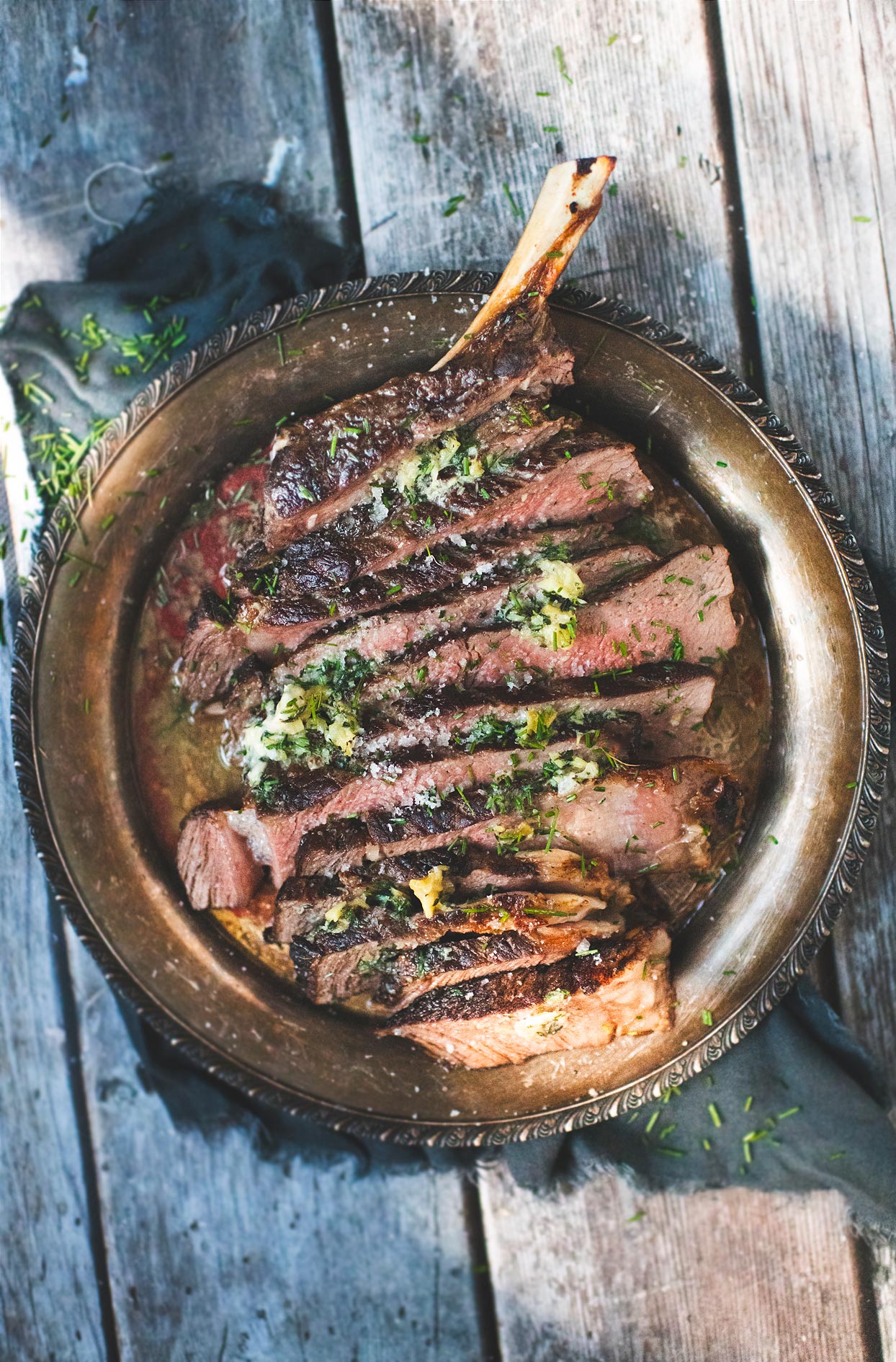
Oven-roasted beef rib steak with roasted garlic butter
- Preparation 1 h 30 min
- Cooking 1 h 15 min
- Servings 3 to 4
- Freezing I do not suggest
Ads
🥩 A $130 cut doesn’t leave room for guessing
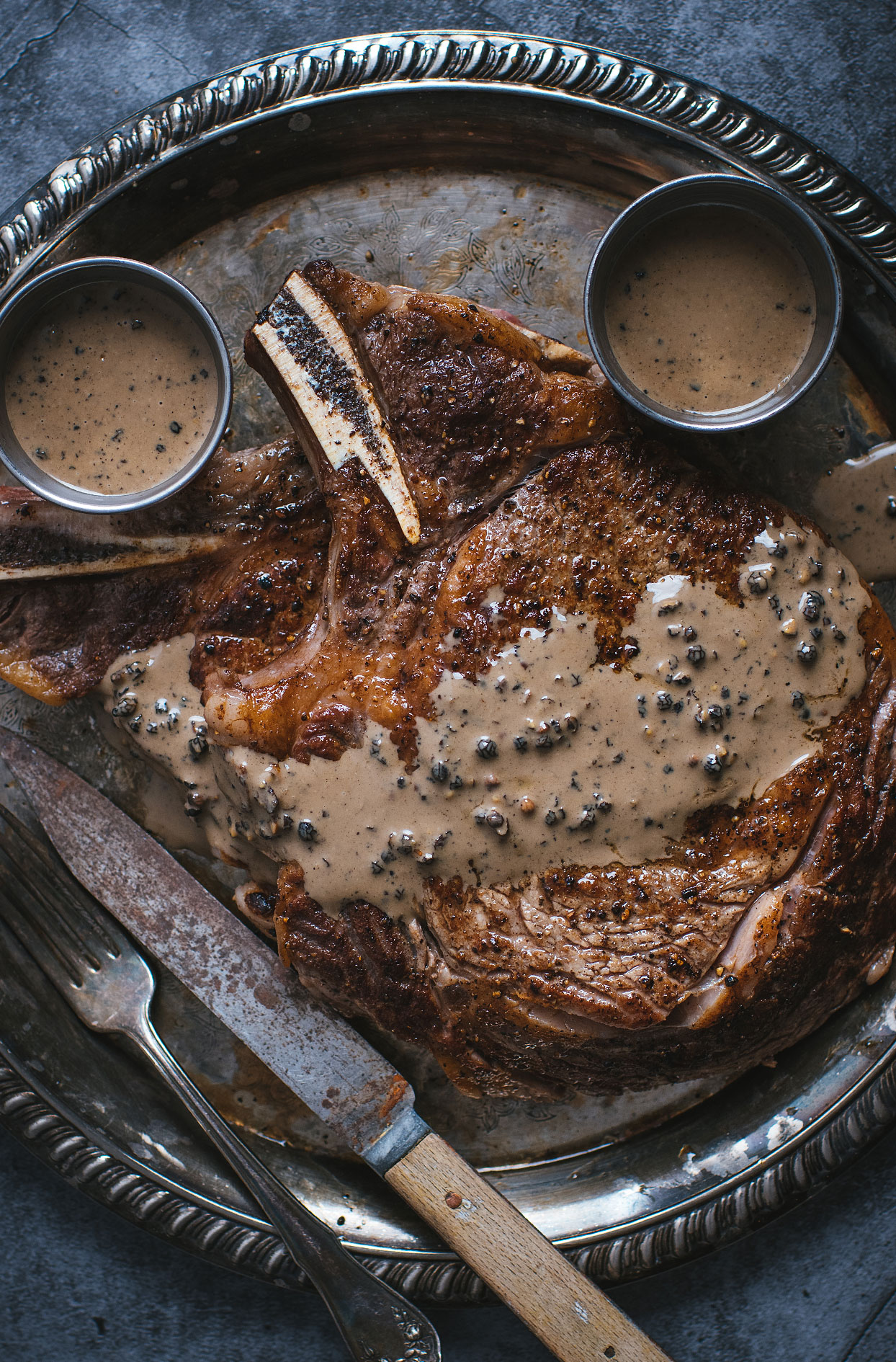
My rib steak cost me $130 for 1.3 kg. When you spend that kind of money on a single piece of meat, you don’t play guessing games with the cook. That’s exactly why this recipe is built around a probe thermometer and reverse searing: two simple tools that completely remove the guesswork. You cook slowly in the oven to the exact temperature you want, sear at the very end for the crust, and you get meat that’s rosy pink from edge to edge. No grey ring, no cold center, no surprise when you slice it in front of everyone.
🧄 The roasted garlic butter is where things get serious
A whole head of garlic that roasts for 45 minutes in the oven has absolutely nothing in common with raw garlic. The cloves turn golden, sweet, creamy, and you mash them directly into softened butter with fresh thyme and rosemary. I never use raw garlic in a butter meant for searing-hot meat: it burns on contact and turns bitter within seconds. Roasted, it’s the opposite. It melts into the beef fat and complements it instead of fighting it. You drop this onto the still-steaming steak and watch the butter run everywhere.
🎉 Christmas, a birthday, special company
This is a special-occasion recipe, and there’s no shame in saying so. At our place, it comes out at Christmas, for a birthday, or when we’re having guests we really want to impress. A 1.3 kg steak feeds 3 to 4 people comfortably, which makes it the perfect format for a celebratory dinner without going full ten-pound roast. Buy it at your local butcher shop, not a big-box grocery store: for a cut like this one, it’s worth talking to someone who slices it in front of you.
Ads
Ads
🌡️ The thermometer is not optional
On a $130 cut, you don’t guess. It’s the only tool that guarantees the result, and internal temperature is the only reliable indicator that exists. Thickness varies too much from one steak to another to rely on time: two pieces of the same weight can need thirty minutes apart. A probe planted in the center, not touching the bone, and you pull the meat out exactly when you need to. It’s the best thirty dollars you’ll invest in your kitchen.
🔄 Why you cook before you sear
Reverse searing means doing the opposite of what your mother showed you. Instead of searing then putting it in the oven, you cook slowly in the oven to your target temperature, and sear only at the end. The result is meat that’s pink from edge to edge, without the grey ring you always see with the traditional method. And since the slow cook has already let the juices redistribute, you need far less resting time at the end.
🧊 That hour on the counter changes everything
Meat pulled straight from the fridge cooks unevenly: the outside is done when the center is still cold. One hour at room temperature on a rack, and your cook becomes uniform from edge to edge. It’s also the perfect time to roast your head of garlic, which takes exactly 45 minutes. Two steps in parallel, zero time wasted.
🧄 Roasted garlic, never raw garlic
This is the detail that makes the difference between a great butter and a bitter one. Raw garlic in butter, in contact with searing-hot meat, burns within seconds and turns sharp and acrid. Roasted for 45 minutes in foil, it loses all its bite: it becomes soft, sweet, creamy, almost confit. It marries the beef fat instead of fighting it. You squeeze the cloves out of their skins like toothpaste and mash them directly into the butter.
🥩 Go to the butcher, not the grocery store
For a cut like this one, it’s worth making the trip. Ask for a bone-in beef rib steak, about 5 cm (2 in) thick, and let the butcher cut it in front of you. You’ll see the quality of the marbling, you’ll be able to choose your exact thickness, and you’ll leave with much better advice than anything you’d get from a self-serve counter. Count 300 to 400 g per person with the bone, which gives 3 to 4 portions for a 1.3 kg steak.
🔪 Detach the bone, then slice against the grain
Don’t struggle to slice around the bone. Run your knife along the bone to detach the whole piece of meat, then lay it flat on your cutting board. Find the direction of the grain and slice perpendicular to it, in slices about 1 cm (½ in) thick. Against the grain, the fibers are cut short and the meat is noticeably more tender. And don’t throw away the bone: it’s the best part, someone in the house is going to want to gnaw on it.
🧈 The roasted garlic butter freezes and goes on everything
Half a cup of butter is more than a single steak needs, and that’s intentional. Whatever’s left, roll it in plastic wrap into a log and freeze it: you cut off rounds as needed. It’s incredible on Grilled corn with chipotle butter, on any other grilled cut of meat, or melted over potatoes. And if you have leftover rib steak, make yourself a killer grilled cheese with sourdough bread and raclette cheese, in the spirit of my Flank steak grilled cheese with raclette cheese.
✅ What to serve with my oven-roasted beef rib steak with roasted garlic butter?
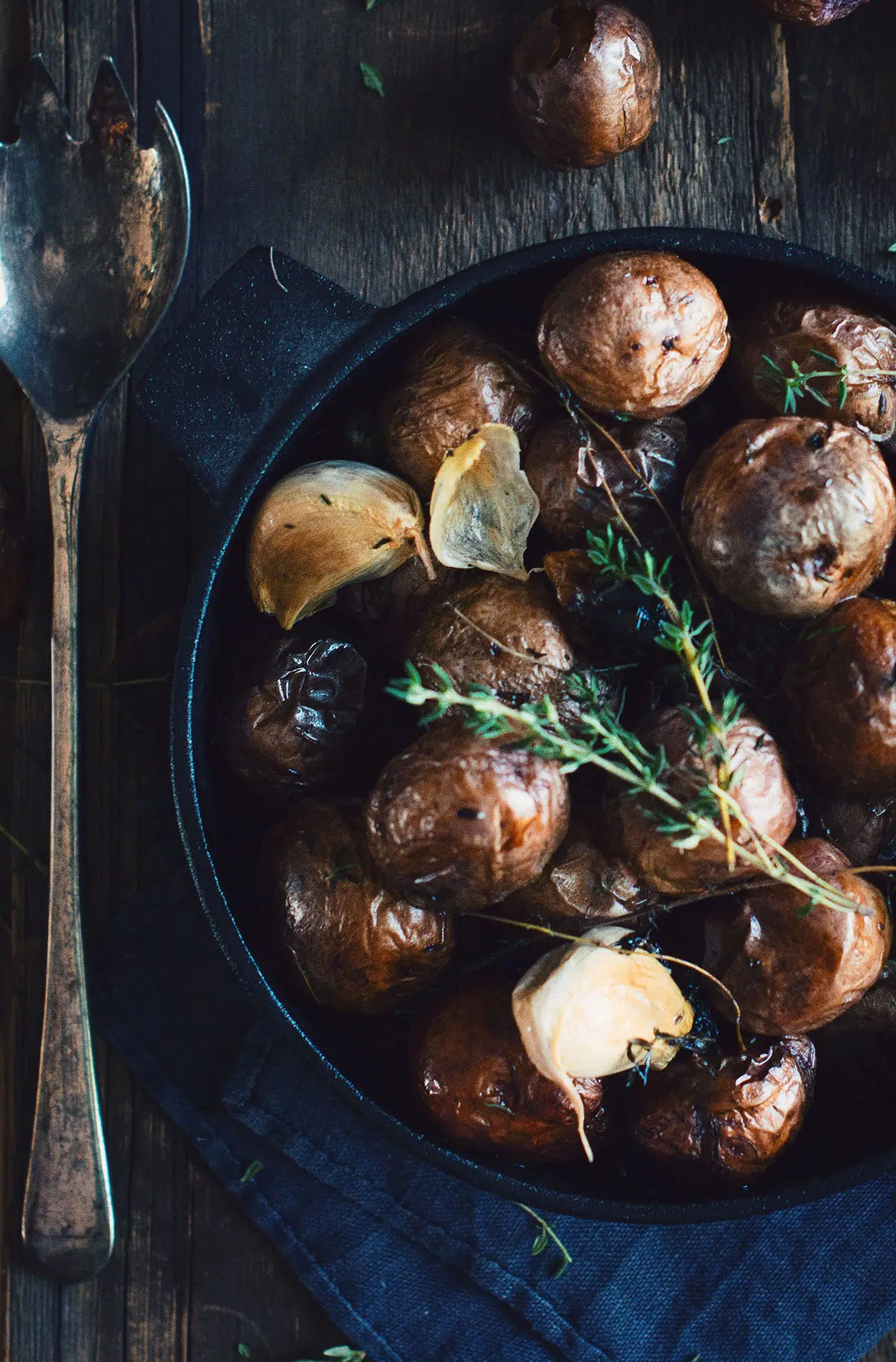
My Baby potatoes with roasted garlic and thyme are the obvious pairing, because they echo the exact garlic-thyme profile of the butter and give you a perfectly cohesive plate. My Sautéed mushrooms in garlic butter and fresh herbs play in the same register and come together while the meat is in the oven. To add freshness and cut through the fat, throw in my Classic Caesar salad or my Grilled BBQ asparagus. And keep my Cheesy garlic bread within reach to soak up the melted butter at the bottom of the plate.

Ads
Beef rib steak
- 1 bone-in beef rib steak, about 1.3 kg (2.9 lb), 5 cm (2 in) thick
- 2 tbsp (30 ml) olive oil
- Fleur de sel
- Freshly ground pepper
- 2 tbsp (30 ml) canola oil
Roasted garlic butter
- 1 whole head of garlic
- 1 tbsp (15 ml) olive oil
- ½ cup (125 ml) unsalted butter, softened
- 2 tbsp (30 ml) fresh thyme leaves
- 1 tbsp (15 ml) fresh rosemary, finely chopped
- 1 tsp (5 ml) fleur de sel
- Freshly ground pepper
Ads
Preparation
- Take the beef rib steak out of the fridge 1 hour ahead of time. Pat it completely dry with paper towels, rub olive oil all over every surface, then season generously with fleur de sel and pepper. Let it rest at room temperature on a rack.
- Meanwhile, preheat the oven to 400 °F (200 °C). Cut the top off the head of garlic to expose the cloves, drizzle with olive oil, wrap in aluminum foil and roast for 45 minutes, until the cloves are golden and creamy. Set aside.
- Squeeze the roasted garlic cloves out of their skins and mash with a fork. Mix into the softened butter along with the thyme, rosemary, fleur de sel and pepper, until you have a smooth, uniform paste. Set aside at room temperature.
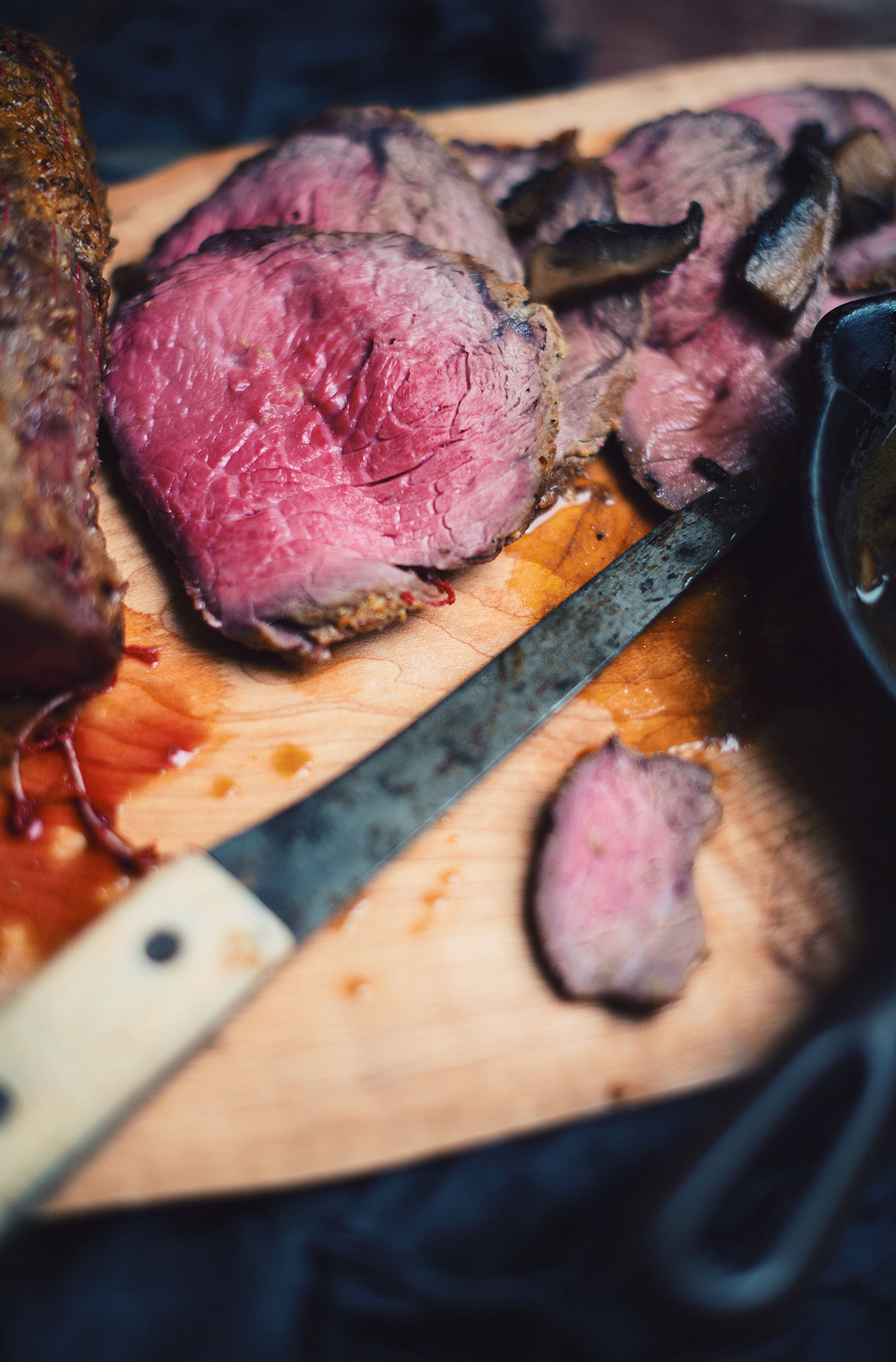
- Reduce the oven to 350 °F (180 °C). Place the beef rib steak on a rack set over a baking sheet and insert a probe thermometer into the center of the meat, without touching the bone. Cook for 45 to 75 minutes, until the internal temperature reaches 118 °F (48 °C) for rare or 125 °F (52 °C) for medium-rare. The cook will finish in the pan.
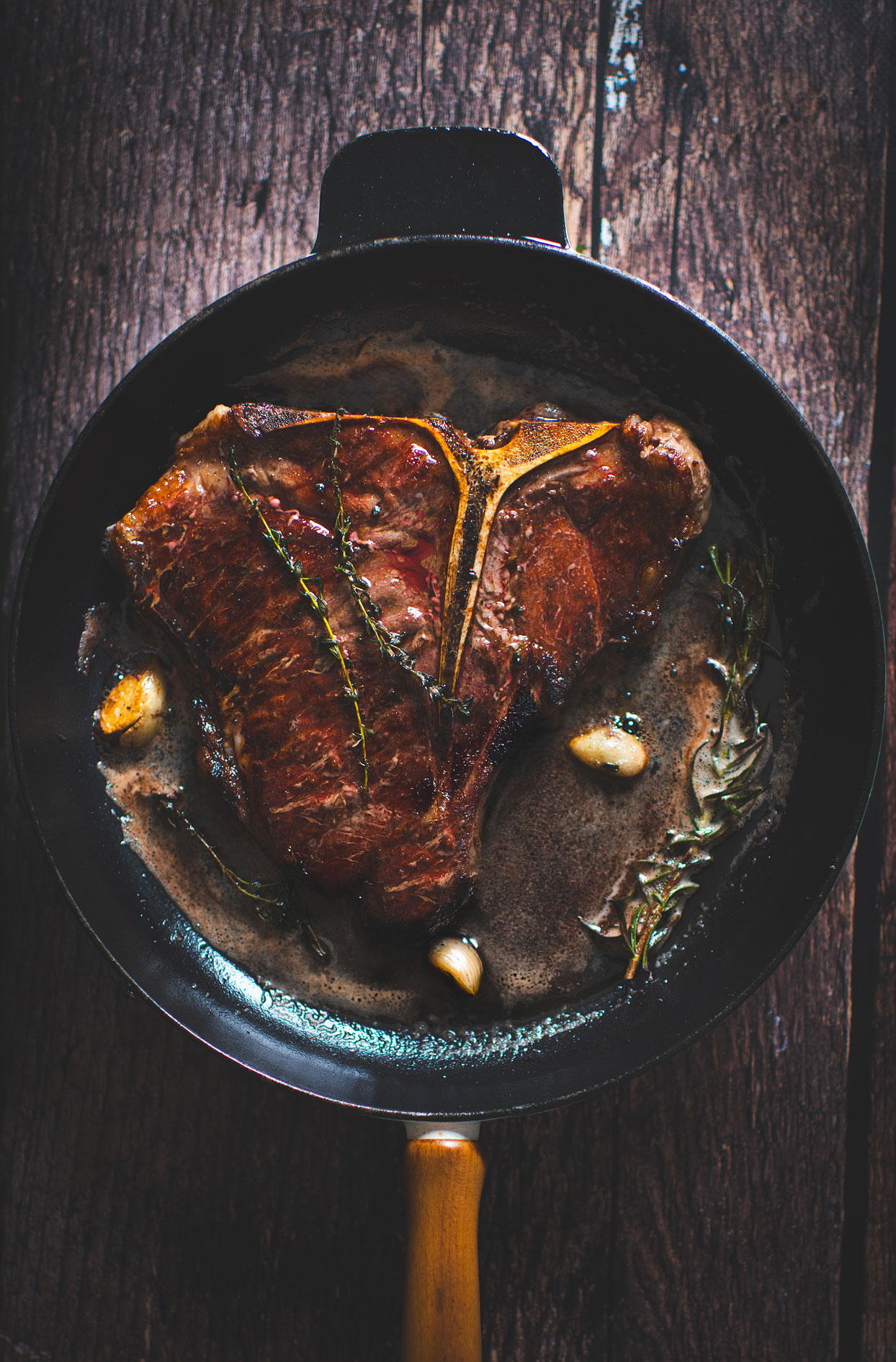
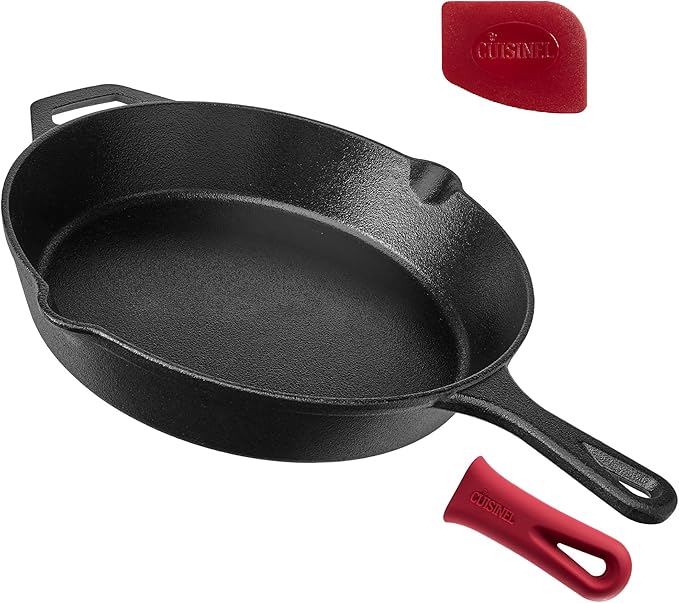
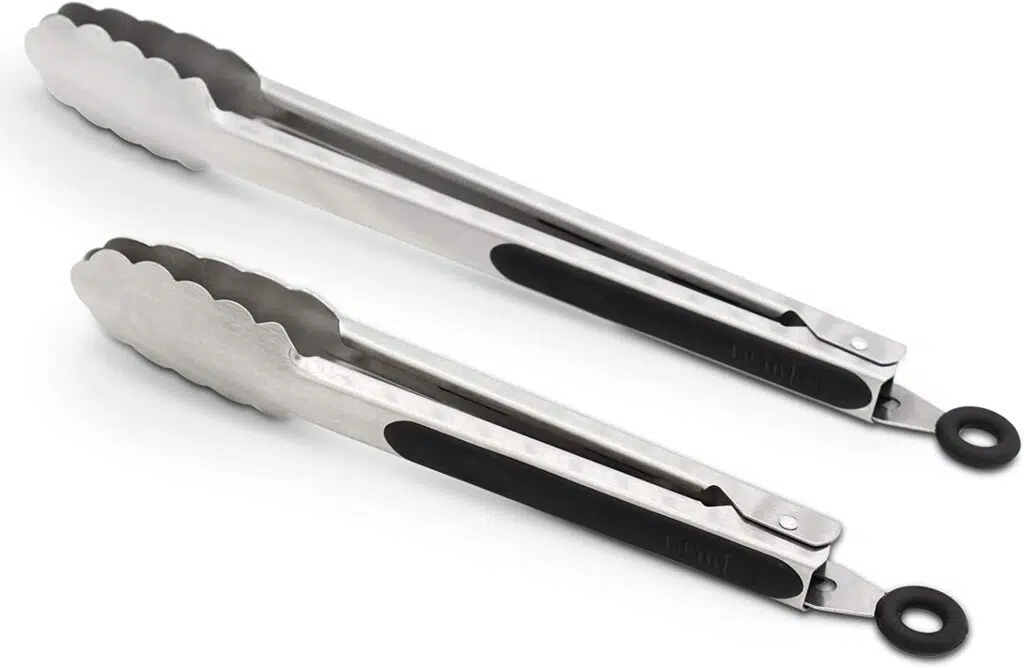
- Heat a cast iron skillet over high heat with the canola oil until it just begins to smoke. Sear the rib steak for 2 to 3 minutes per side, then hold it upright with tongs to sear the fatty edges as well, until a deep, dark crust forms all around.
- Remove from heat and generously spread the roasted garlic butter over the hot meat, spreading it as it melts. Wrap in aluminum foil and let rest for 5 to 10 minutes.
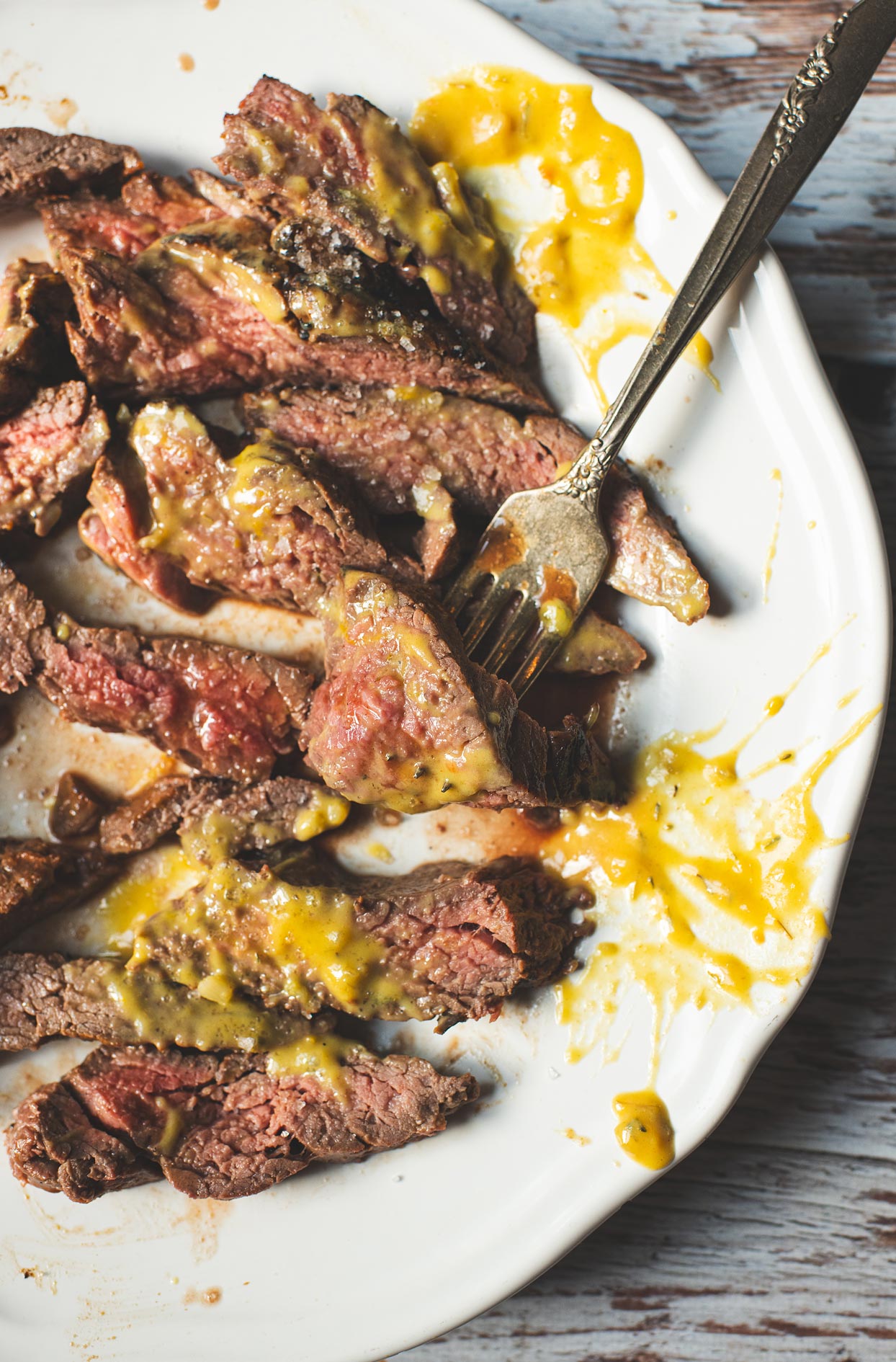
- Detach the meat from the bone, then slice against the grain into 1 cm (½ in) slices. Spoon the melted butter that has pooled in the pan over top and finish with a pinch of fleur de sel.
Reverse searing, without hesitation. You first cook the piece slowly in the oven at 350 °F until the center reaches your target temperature, then sear it over high heat in a cast iron skillet for two or three minutes per side to build the crust. It’s the opposite of the classic method, and it’s clearly superior for a thick cut: the gentle heat rises slowly and evenly, which eliminates the grey ring of overcooked meat between the crust and the rosy center. The crust forms at the very end on an already-hot surface, so it develops in seconds. The only indispensable tool is a probe thermometer.
Pull it from the oven at 118 °F (48 °C) for rare, or at 125 °F (52 °C) for medium-rare. These numbers are intentionally lower than the final target temperature, because the sear in the pan and the resting time will bring the center up a few more degrees. If you wait to hit the final temperature in the oven, you’ll overshoot your target by the time you serve. For all other cuts and all degrees of doneness, I’ve compiled everything in my guide des températures de cuisson des viandes et du poisson.
The same principle applies, using indirect heat. Light only one side of the barbecue, aim for about 350 °F in the chamber, and place the steak on the unlit side with your probe thermometer inserted in the center. When it hits 118 °F, transfer it directly over the lit burners at maximum heat and sear it two or three minutes per side, making sure to get the fatty edges too. The roasted garlic butter goes on exactly the same way afterward. The advantage of the barbecue is a subtle smoky note. The downside is that the temperature is harder to stabilize than in the oven.
Count 300 to 400 g per person with the bone, which means a 1.3 kg steak comfortably feeds 3 to 4 people. For buying, go to your butcher rather than a big-box grocery store: you see the marbling, you choose your exact thickness, and you can ask for a 5 cm (2 in) cut that’s hard to find pre-packaged. Brace yourself, though: mine cost $130. This is a special-occasion cut, not a Tuesday-night dinner.
My baby potatoes with roasted garlic and thyme are the first choice, because they echo the same flavor profile as the butter. Add my sautéed mushrooms in garlic butter and fresh herbs, which come together while the meat cooks, and a grilled green vegetable like my grilled bbq asparagus to balance it all out. A classic caesar salad to start and you’ve got a complete celebration meal.
Ads
Ads
Ads
Ads
Ads