

Homemade Italian sausages

- Preparation 1 h 30 min
- Refrigeration 15 to 20 min
- Servings about 30 six-inch sausages
- Freezing Absolutely
Ads
🇮🇹 The charcuterie project that fills up the freezer
My homemade Italian sausages are my favourite weekend project. When you have a good sausage stuffer and you’ve got the technique down, you can make a big batch really quickly and have enough for months. I vacuum-seal them all, date them and pop them in the freezer. Even after 3 months, they’re still completely delicious, as fresh as the day they were made. It’s a handy thing to have in your arsenal, it fills up the freezer, and everyone loves them. With 3.5 kg of meat, you get about 30 six-inch sausages. Enough to feed your family all fall and winter.
🍊 The orange zest, my signature twist
What sets my version apart from classic Italian sausages is the addition of the zest of a whole orange. Nobody does it, but it really changes everything. The zest lifts all the flavours alongside the fennel. Those two ingredients are made for each other. It’s what you just can’t replicate with store-bought Italian sausages that all taste the same and bland. With my 3 tablespoons of dry-toasted fennel seeds, the white wine, fresh parsley and orange zest, I get a flavour profile that really pops.
👧 The ritual to do with your crew or your kids
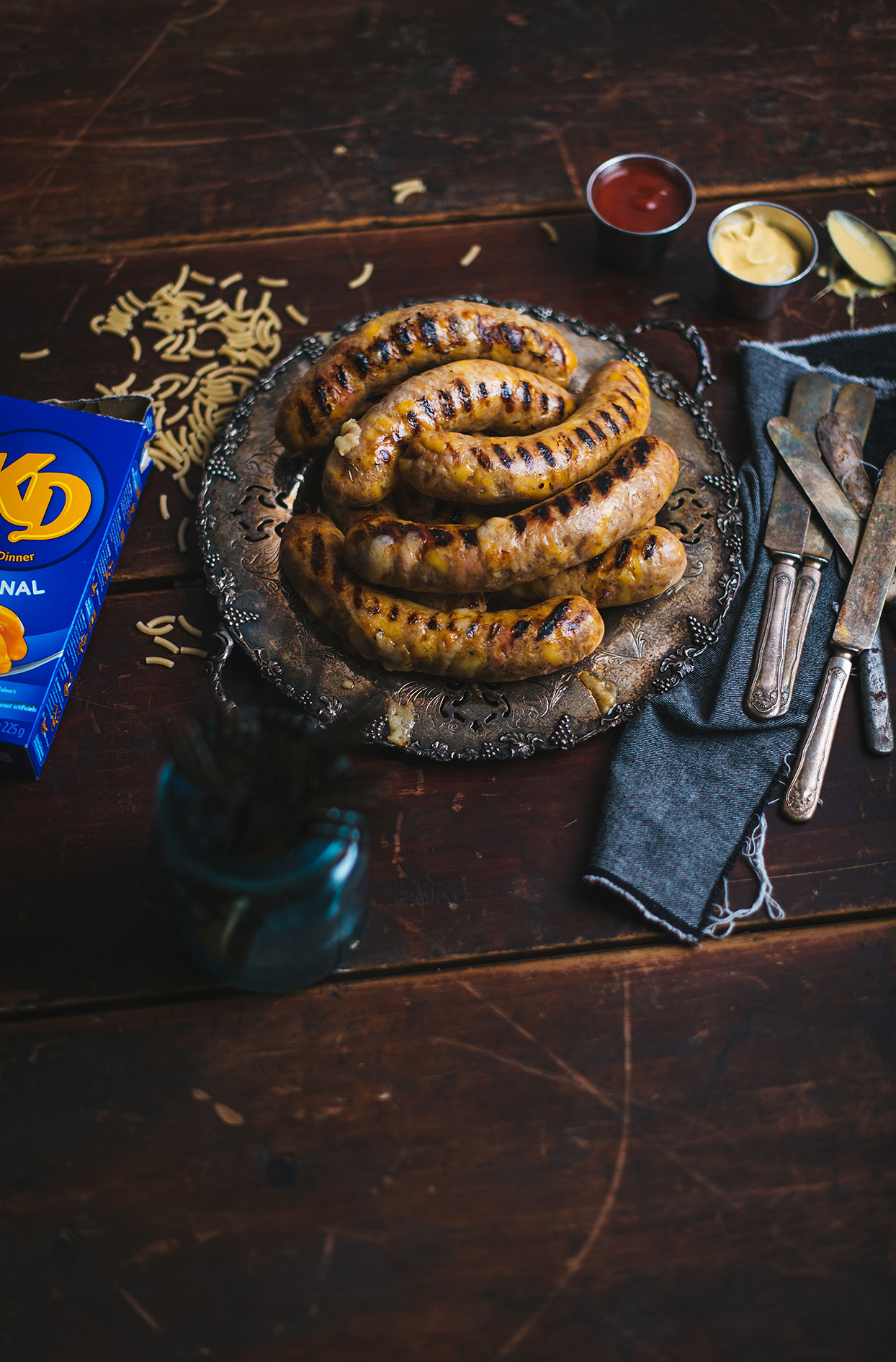
This is exactly the kind of project I love doing with my kids or a group of friends. You get 3, 4 people together, share the work (one cuts the shoulder, another runs the spice grinder, another pushes the sausages through the stuffer), and in 2 hours you’ve got 50, 60 homemade Italian sausages to split between you. You can even take the opportunity to make my apple, cheese curd & blonde de chambly beer sausage and my kraft dinner sausages with smoked ham and sharp cheddar at the same time to vary the batch. Three kinds of sausages in one afternoon. That’s a good time.
Ads

Ads
🥓 Pork shoulder: the right fat ratio for a juicy sausage
Pork shoulder is the perfect cut for Italian sausages because it naturally has the right fat ratio. You’re aiming for about 25 to 30% fat in the meat (standard 70/30 or 75/25 ratio). That’s what gives you a juicy sausage that doesn’t dry out during cooking and has that signature soft texture. Too lean = dry and flat sausage. Too fatty = a sausage that oozes grease in the pan. Pork shoulder naturally sits in the ideal zone. Go to your butcher, not big-box grocery stores like Maxi or similar. Ask for ground pork shoulder for sausages and you’ll get the right quality.
🌾 Dry-toasting the fennel and coriander seeds
My trick to amplify the flavour: before running them through the spice grinder, I lightly toast my fennel and coriander seeds dry in a skillet over medium heat for 1 to 2 minutes. You can smell the aroma releasing. It’s intense. Toasting unlocks the essential oils that are dormant in raw seeds and gives a much deeper, more complex flavour to the finished sausage. A 2-minute step that changes the whole result.
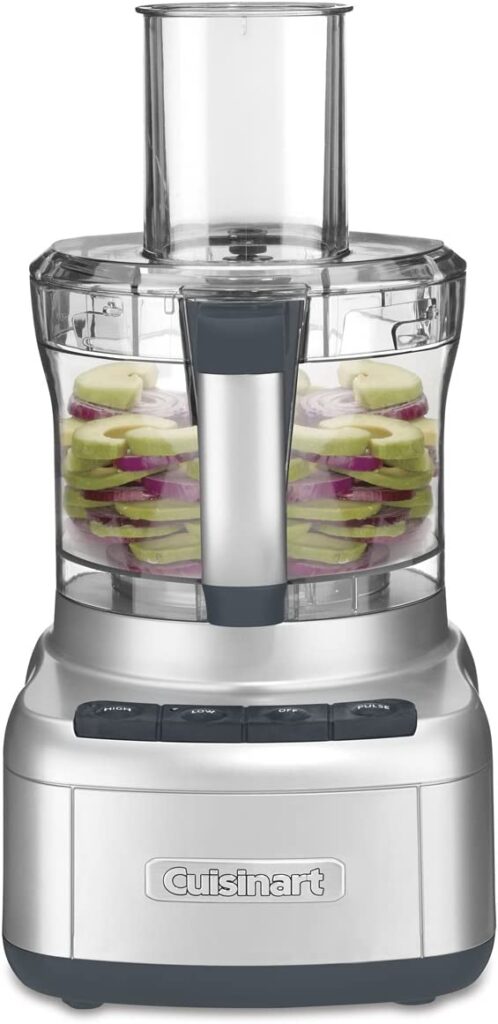
🌾 Spice grinder, food processor or blender. Rustic texture, not powder
You can use a dedicated spice grinder, a food processor or even a blender. Whatever the tool, the critical rule: don’t grind to a fine powder. Pulse 10 to 15 times to lightly crack the seeds while keeping some rustic texture. That texture is what makes the sausage interesting. When you bite into it, you get little pieces of fennel and coriander that burst in your mouth.
first, it keeps the meat very cold during mixing (essential so the fat doesn’t “bake” and the sausages keep their juicy texture). Second, it hydrates the mixture so the meat pushes easily through the casing when stuffing. Without the ice, your mixture would be too dry and too warm.
🔥 The cooking test BEFORE stuffing. A non-negotiable step
This is the step beginners forget and then regret. Before committing to 30 sausages, cook a small patty of the mixture in a skillet for 2 to 3 minutes per side and taste it. That’s when you make adjustments: not enough salt? Add some. Missing spice? Add some. Not spicy enough? Add more pepper flakes. This is your only chance to fix things before everything is stuffed. Once it’s in the casing, there’s nothing you can do.
🌶️ Spicy variation: 3 tablespoons of hot pepper flakes
To turn my mild version into a spicy one, increase the hot pepper flakes from 1 tsp to about 3 tablespoons per 3.5 kg of meat. That’s roughly equivalent to ½ tablespoon per pound, the standard ratio for a balanced spicy Italian sausage. Personally, I eat them mild and have never made the spicy version, but that’s the ratio recommended by most professional recipes. Do a cooking test before stuffing to adjust to your heat tolerance.
🧊 Vacuum sealing for 3 months in the freezer
My favourite trick for storage: I make packs of 4 to 6 sausages vacuum-sealed with a vacuum sealer, write the date directly on the bag and pop them in the freezer. Vacuum-sealed, the sausages stay fresh for up to 3 months with no loss of flavour or texture. They come out tasting like they were just made. Without a vacuum sealer, you can freeze them in tightly pressed zip-lock bags, but the shelf life drops to 2 months max and you risk freezer burn.
✅ What to serve with my homemade Italian sausages?
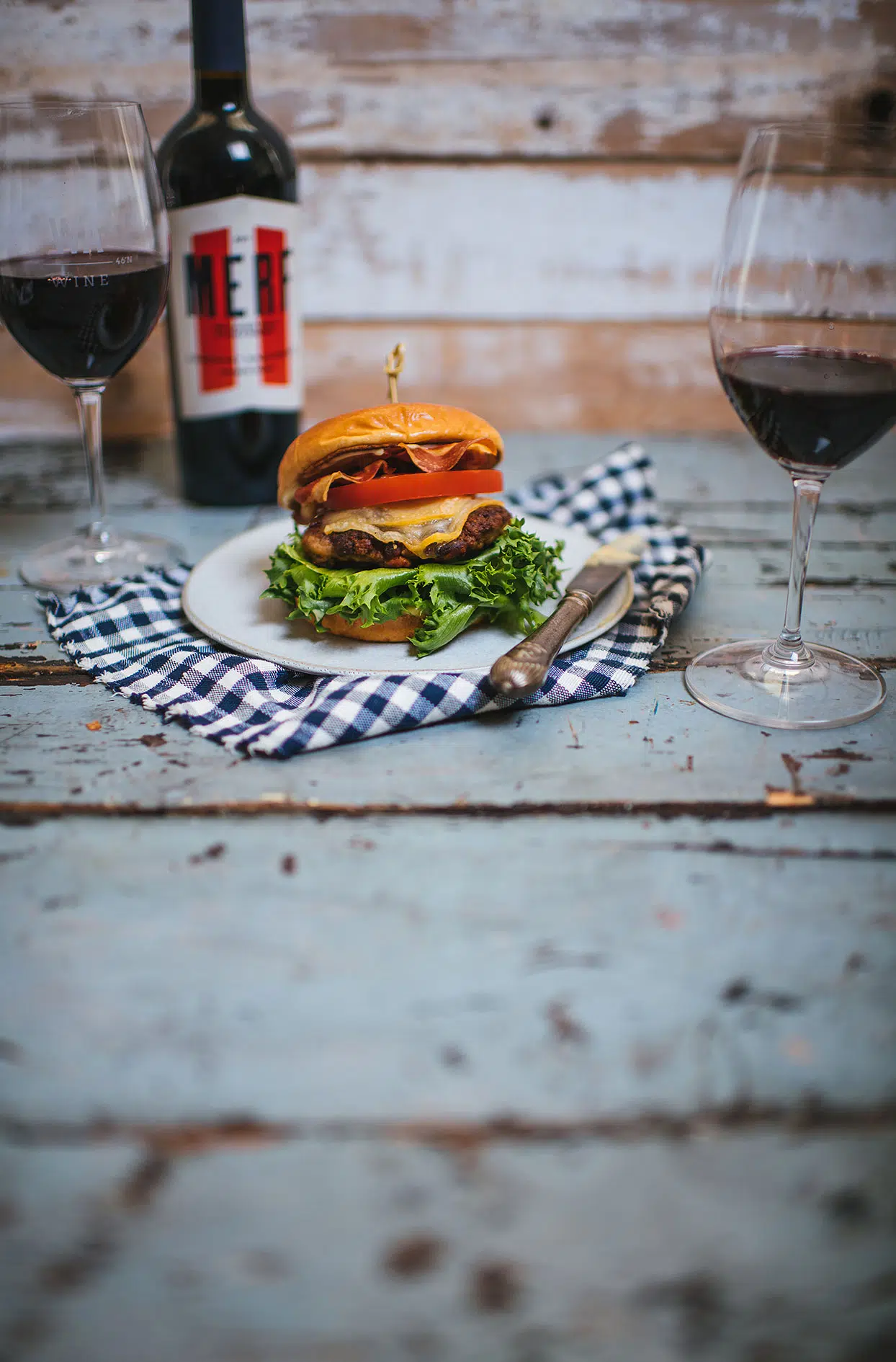
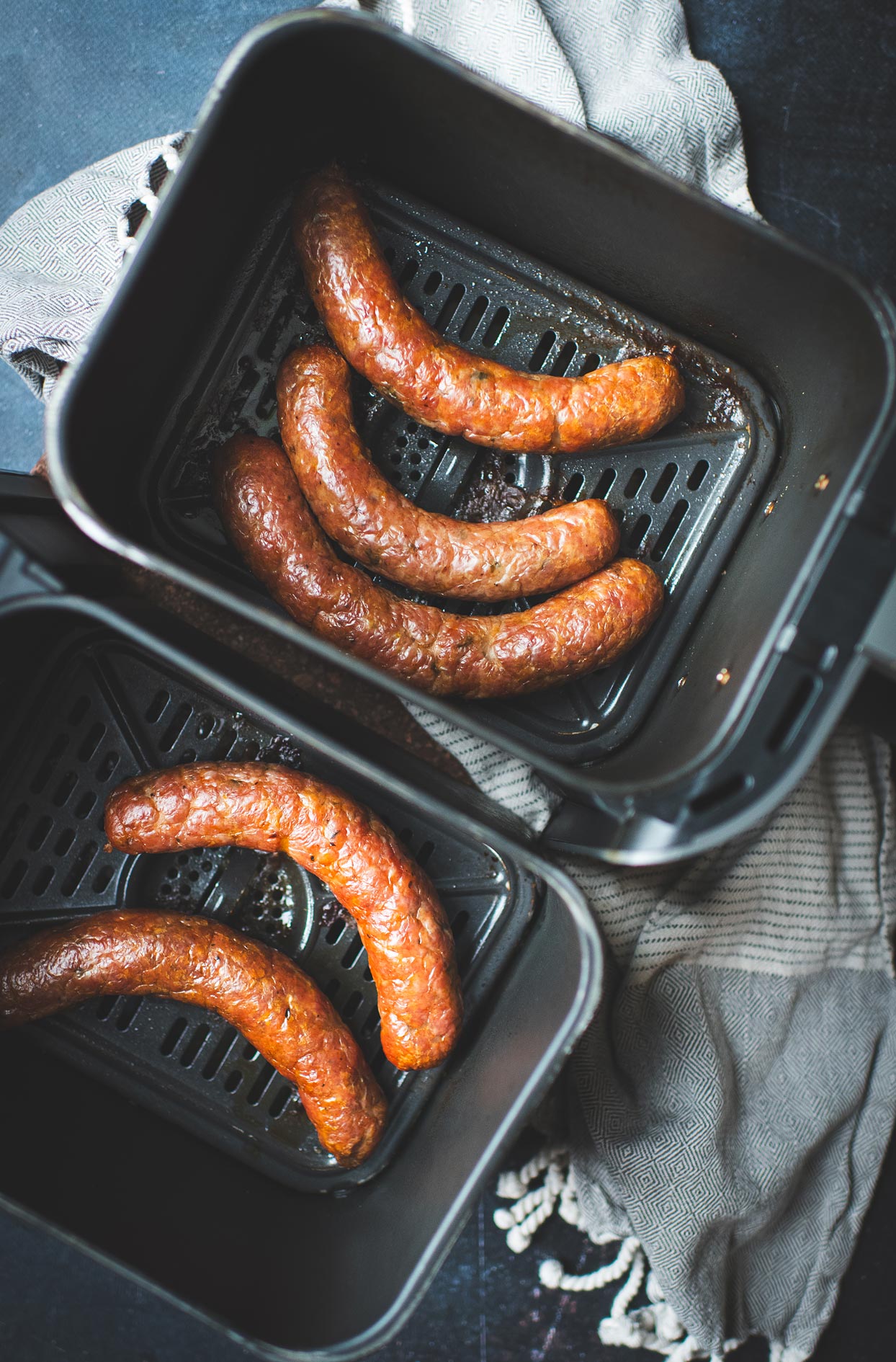
Once cooked, my Italian sausages are perfect grilled on the BBQ or in a skillet, served alongside some great grilled broccoli, roasted carrots, an arugula salad with balsamic vinaigrette and grilled halloumi for a complete Mediterranean meal. You can also use them in my Spicy Italian sausage burgers with haloumi cheese, my Farfalles with italian sausages and grape tomatoes, my Italian sausages, dried tomatoes and arugula risotto or my Rapini and Italian sausages pizza. To learn how to cook them perfectly, check out my guide How to cook sausages in an air fryer.

Ads
For the sausages
- 15 to 18 ft (4.5 to 5.5 m) of natural pork casing
- 3.5 kg ground pork shoulder
For the spice blend
- 3 tbsp (45 ml) fennel seeds
- 3 tbsp (45 ml) sea salt
- 2 tbsp (30 ml) sugar
- 1 tbsp (15 ml) dried basil
- 1 tbsp (15 ml) dried oregano
- 1 tbsp (15 ml) black pepper
- 1 tbsp (15 ml) paprika
- 2 tsp (10 ml) coriander seeds
- 1 tsp (5 ml) hot pepper flakes (optional)
- ½ tsp (2.5 ml) ground nutmeg
For the wet mixture
- ½ cup (125 ml) white wine
- ⅓ cup (80 ml) chopped fresh parsley
- 3 tbsp (45 ml) grated garlic
- Zest of 1 orange
Ads
Preparation
- Place the pork casing in a medium bowl and cover with cold water. Set aside.
- In a large bowl, add the ground meat.
- In a dry skillet over medium heat, lightly toast the fennel and coriander seeds for 1 to 2 minutes, until they release their aroma. Transfer to a spice grinder (or a food processor or blender) along with the basil, oregano, nutmeg, pepper flakes, black pepper, salt, paprika and sugar. Pulse 10 to 15 times to lightly crack the fennel and coriander while keeping some texture. Not a fine powder.
- Add the spice blend to the ground meat along with the grated garlic, white wine, chopped fresh parsley and orange zest. Mix with your hands until everything is well combined.
- Cook a small piece of the sausage mixture in a skillet and taste to adjust the seasoning (add salt, spices or heat as needed). Then return the mixture to the freezer or refrigerator for 15 to 20 minutes to keep it cold before stuffing.
- Run a little water through the casing to rinse it thoroughly.
- Attach the casing to the nozzle of the sausage stuffer, tie a knot at the end, then push the chilled meat through at low speed to fill the casing evenly.
- Continue filling until all the meat is used up.
- Hold the filled casing at the centre and pinch it. Move down about 6 inches (15 cm), pinch again and twist the two sections together.
- Pass one of the free links through the opening of the two twisted 6-inch links, then repeat the process until all the sausage is linked.
- Tie a double knot at the end of the links and cut off the excess. Vacuum-seal in packs of 4 to 6 sausages, label with the date and keep in the fridge for 3 to 4 days or in the freezer for up to 3 months.
Any traditional butcher shop sells natural pork casings. Just ask for “sausage casings for Italian sausages” and your butcher will pull out the right size. Avoid big-box grocery stores, which almost never carry them. Good spots in Quebec: neighbourhood butcher shops, public markets, specialized Italian butcher shops. Casings keep in salt in the fridge for months, so you can buy several lengths in advance to make multiple batches.
Honestly, yes, it’s essential. I really don’t suggest trying to make sausages without a sausage stuffer. Without that equipment, stuffing becomes extremely frustrating, slow, and the sausages tear. You can rent a stuffer from some hardware stores or specialty butcher shops (an economical option for a one-time project), or buy one for around $100 to $200 if you plan on making sausages regularly. With a good machine and the technique mastered, you can get through 3.5 kg of sausages in under 2 hours.
In the fridge: 3 to 4 days maximum in an airtight container or in their vacuum-sealed packaging. In the freezer: up to 3 months vacuum-sealed in packs of 4 to 6 sausages with the date written on the bag. Without vacuum sealing, the shelf life drops to about 2 months in the freezer (the sausages risk freezer burn and loss of flavour). To thaw, transfer a pack to the fridge the night before. Never thaw at room temperature for food safety reasons.
You’re aiming for about 25 to 30% fat in the ground meat (standard 70/30 or 75/25 lean-to-fat ratio). That’s the perfect ratio for a juicy sausage that doesn’t dry out during cooking and has that signature soft texture. Pork shoulder is naturally in that ideal zone thanks to its fat-to-lean marbling. Too lean (like pork tenderloin) = dry and bland sausage. Too fatty = a sausage that oozes grease and loses flavour. Ask your butcher to grind the whole pork shoulder (with its natural fat). Not extra-lean ground pork.
For the spicy version, increase the hot pepper flakes from 1 teaspoon to about 3 tablespoons per 3.5 kg of meat (equivalent to ½ tbsp per pound). You can also add ½ teaspoon of crushed chili for an extra layer of heat. Always do a cooking test with a small piece before stuffing to adjust to your tolerance. You can always add more, but you can never take it out once it’s mixed in. Personally, I eat them mild and have never stuffed a spicy version.
Ads
Ads

Ads
Ads
Ads