

Mille-Feuille Recipe (Napoleon Pastry)
- Preparation 45 min
- Refrigeration 4 h 30 min
- Cooking 30 min
- Servings 5
- Freezing I do not suggest
Ads
🥐 A real mille-feuille, not a shortcut version
Search for mille-feuille and you’ll find a lot of things that aren’t one. Pudding layered between graham crackers, aerosol whipped cream stacks. They taste fine. They’re not the same dessert. A mille-feuille is puff pastry baked flat until it genuinely snaps, real vanilla pastry cream, and a marbled glaze on top. Three elements, no shortcuts.
🍦 The contrast is the whole dessert
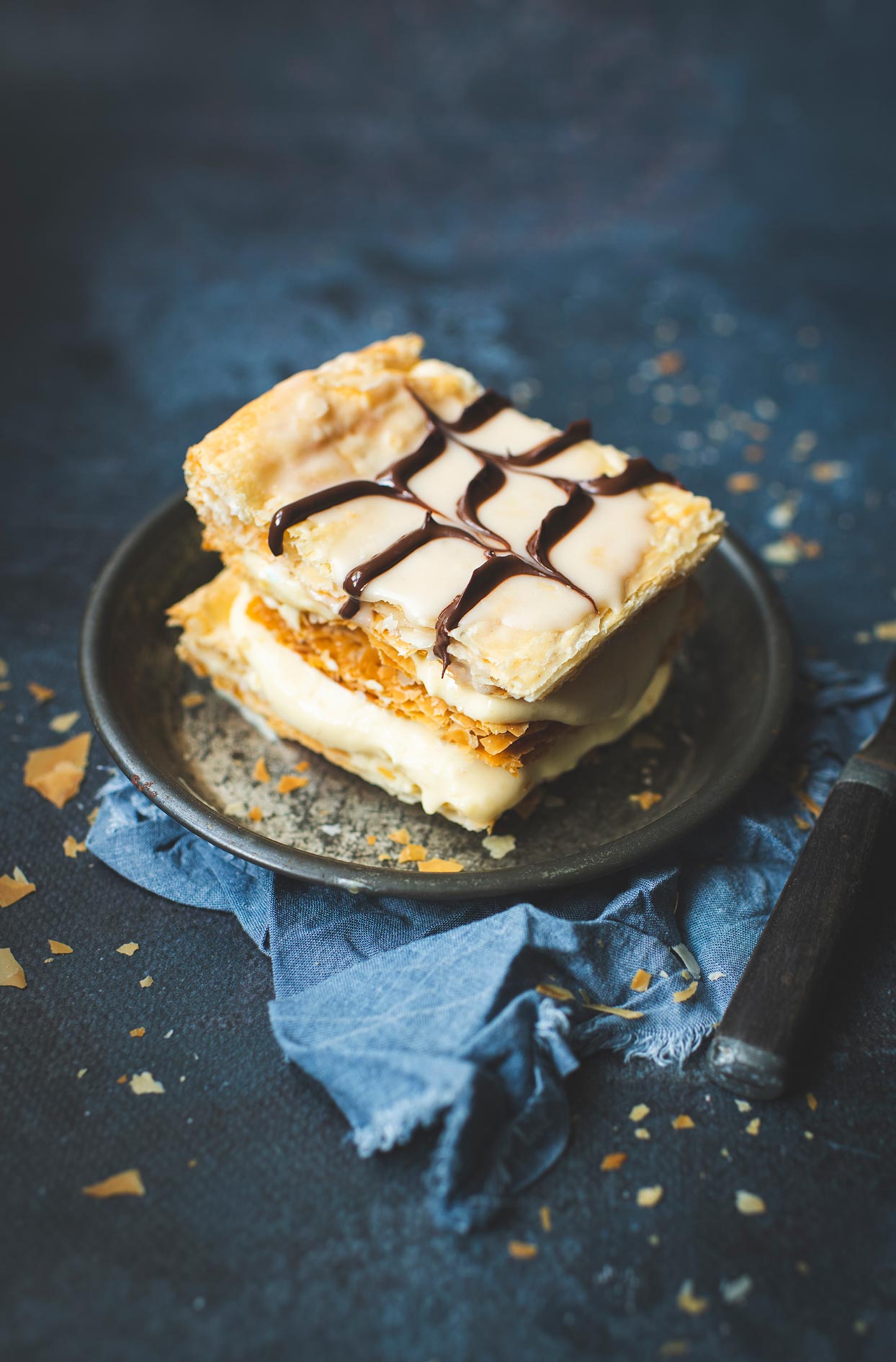
A good mille-feuille is two textures that have nothing in common, meeting in every bite. Pastry that snaps under the fork, cream that melts underneath. If the pastry softens, you’re left with a soggy stack. If the cream is bland, the pastry has nothing to carry.
That’s why I use a real vanilla bean on top of the extract. You can see the black specks in the cream, and you can taste the difference. Extract alone is fine. With the seeds, the cream becomes the heart of the dessert instead of just glue between two layers of pastry.
🍫 The decoration is easier than it looks
Chocolate chevrons over white glaze are what make a mille-feuille look like it came from a pastry shop. And it’s honestly easy: four lines of melted chocolate, a toothpick dragged through in alternating directions, done. Mine worked on the first try. The only trick is wiping the toothpick between each pass, otherwise you drag chocolate through the white.
Ads
Ads
🥄 Loosen the pastry cream before folding
This is where it all happens, and where I got it wrong the first time. Pastry cream straight from the fridge is set solid. Dump it into the whipped cream and beat to combine, and you break the starch gel holding everything together. Once broken it never reforms, and your cream runs at assembly. Loosen it on its own, with a whisk, in its bowl, until smooth. Only then fold in the whipped cream with a spatula.
🥣 Medium peaks, never stiff
You’d think firmer whipped cream would hold better. It’s the opposite. Over-whipped cream is rigid, it refuses to incorporate, and you end up beating longer to combine it. That beating is exactly what destroys the structure. Stop when the whisk leaves a clear trail that slowly folds over on itself.
🌡️ The second bake depends on your oven
Figure 12 to 15 minutes uncovered, but go by colour rather than the timer. You want a deep golden brown, not pale blonde. Underbaked pastry softens twice as fast once it’s filled, and that’s the difference between a mille-feuille that snaps and one that bends.
🍫 Wipe the toothpick between each pass
The chevron pattern happens on its own if you respect this. Four lines of chocolate over still-wet glaze, then drag the toothpick across, alternating directions. But each pass picks up chocolate, and if you don’t wipe it, you drag that chocolate through the white on the next line. Keep a square of paper towel beside you and it’s handled.
⏲️ Thirty minutes of cold, minimum
Honestly: the first time, I was so impatient I ate them right away. They tasted great, but they slid apart. Half an hour in the fridge lets the glaze set and the cream firm up, and the mille-feuille holds far better under a knife. Don’t skip it the way I did.
📅 Prep ahead, assemble fresh
A mille-feuille gets built at the last minute or the pastry goes soggy. But nearly everything else can be done in advance. The pastry cream keeps one to two days, covered with plastic pressed to the surface. The pastry bakes the day before and keeps whole or already cut into squares, in a container at room temperature, up to 24 hours. The glaze takes two minutes on the day. Come serving time, all that’s left is finishing the cream, decorating and stacking, and you’re looking at fifteen minutes. Never assemble more than 8 hours ahead.
❄️ Storage
Assembled mille-feuilles keep up to 3 days in an airtight container in the fridge, though the pastry softens over time. They also freeze: let the glaze set at least 30 minutes, wrap them individually and freeze up to 3 months. Thaw in the refrigerator, knowing the pastry will lose some of its crispness.
🍫 Use bar chocolate, not chips
Skip chocolate chips, which contain stabilizers and won’t melt to the right consistency for piping. Use baking chocolate in bar form, semisweet or bittersweet. The 2 oz (57 g) in this recipe yields about 1/4 cup (60 ml) melted, plenty to decorate all 5 squares.
✅ What to serve with mille-feuille
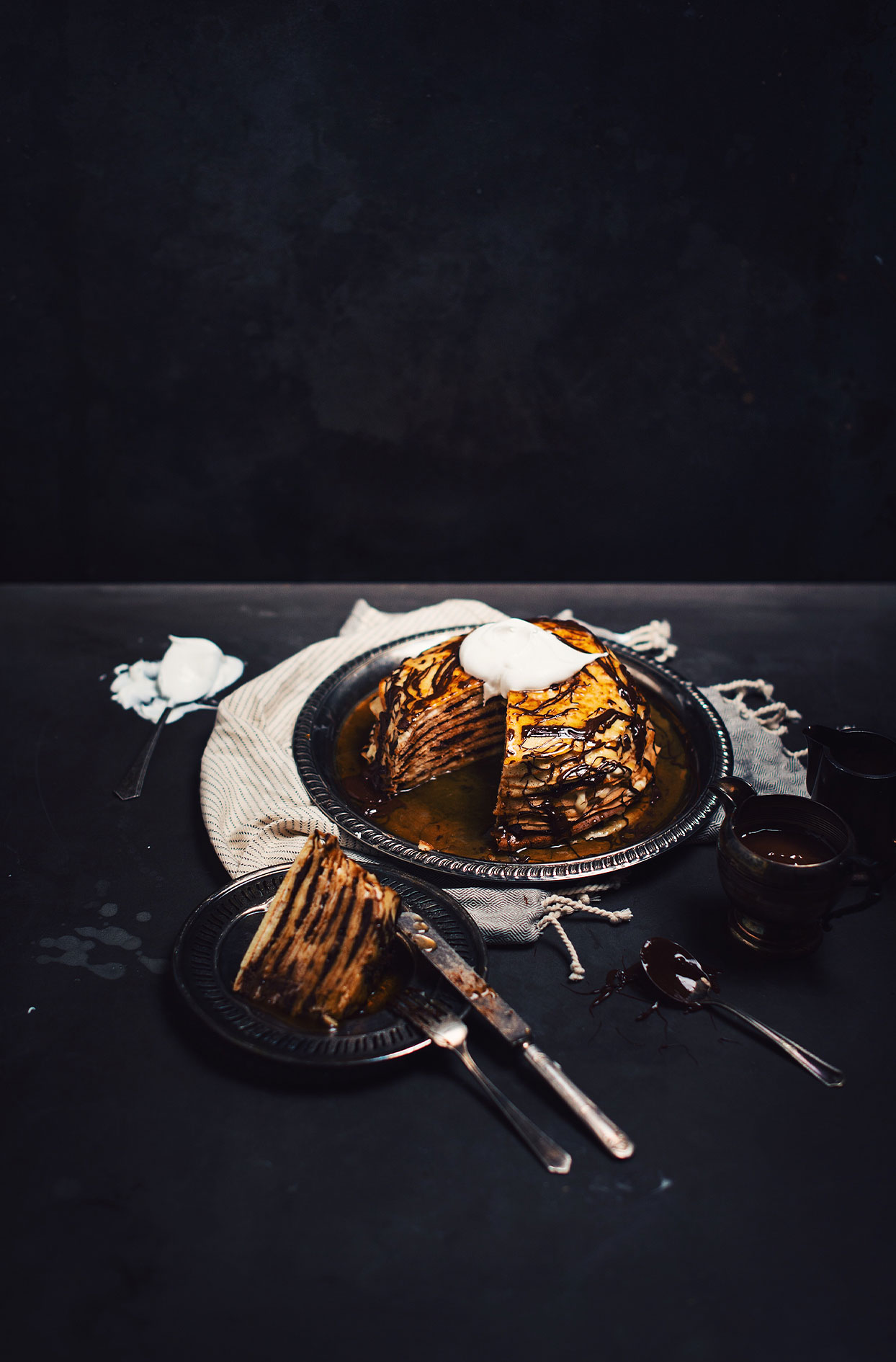
It stands on its own with a good coffee. If you’re building a dessert table, my berry and custard tart plays on the same cream, and my tiramisu style chocolate crêpe cake brings a completely different texture.
Ads
Pastry
- 1 lb (450 g) puff pastry, homemade or store-bought, thawed (2 sheets)
- All-purpose flour, as needed for rolling
Pastry cream
- 4 large egg yolks
- 4 tbsp (30 g) cornstarch
- 2 cups (500 ml) whole milk
- 1/2 cup (125 ml) granulated sugar
- 1 tbsp (15 ml) unsalted butter, softened
- 1 tsp (5 ml) pure vanilla extract
- Seeds from half a vanilla bean
- 1 pinch of salt
- 1/2 cup (125 ml) heavy cream 35%, cold
Topping
- 1 cup (250 ml) powdered sugar, sifted
- 1 1/2 tbsp (22 ml) milk
- 1/2 tsp (2 ml) pure vanilla extract
- 2 oz (57 g) semisweet chocolate, roughly chopped
Ads
Preparation
- Make the pastry cream. In a large heatproof bowl, whisk the egg yolks and cornstarch with a fork until thick and smooth. If it stays dry, add a few drops of milk to bring it together. Set aside.
- In a medium saucepan over medium heat, whisk the milk and sugar until the sugar dissolves, then bring to a gentle simmer. Remove from heat.
- Slowly pour the hot milk over the yolks, whisking constantly so they don’t cook. Strain the mixture, then return it to the saucepan.
- Return to medium heat and whisk constantly. The mixture will foam, then thicken quickly with large bubbles breaking at the surface, about 1 to 2 minutes. Let the bubbles break for a good twenty seconds, until it reaches a pudding consistency. A thermometer should read 185 to 190 °F (85 to 88 °C). Remove from heat.
- Whisk in the butter, vanilla extract, vanilla seeds and salt. Let cool 10 minutes, then strain a second time for a perfectly smooth cream.
- Transfer to a bowl and press plastic wrap directly onto the surface to prevent a skin from forming. Refrigerate at least 3 hours, up to 24 hours.
- Preheat the oven to 400 °F (204 °C). Line a 12 x 17 in (30 x 43 cm) baking sheet with parchment paper. Keep a second sheet and another piece of parchment within reach.
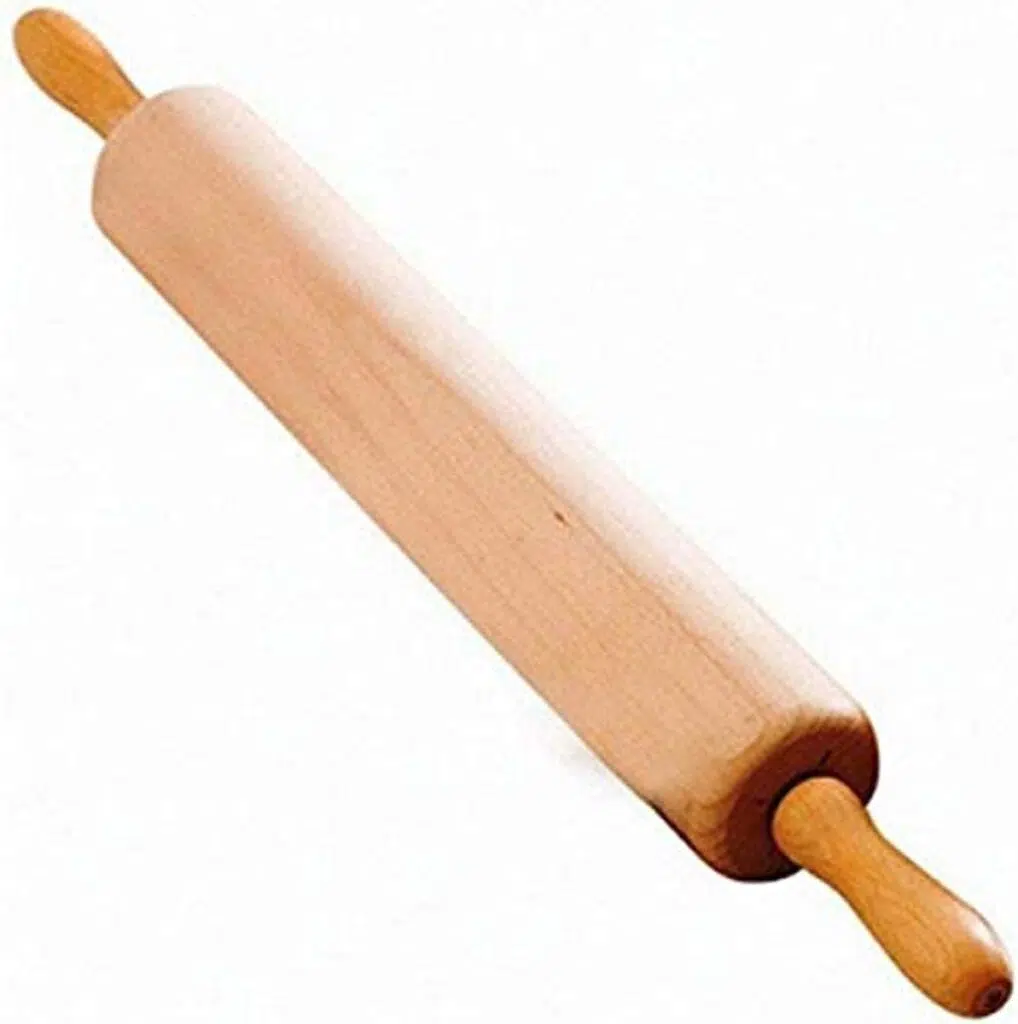
- On a floured surface with a floured rolling pin, roll the pastry into a rectangle about 11 x 16 in (28 x 40 cm). With two store-bought sheets, lay them side by side with the edges overlapping in the centre and seal them together as you roll.
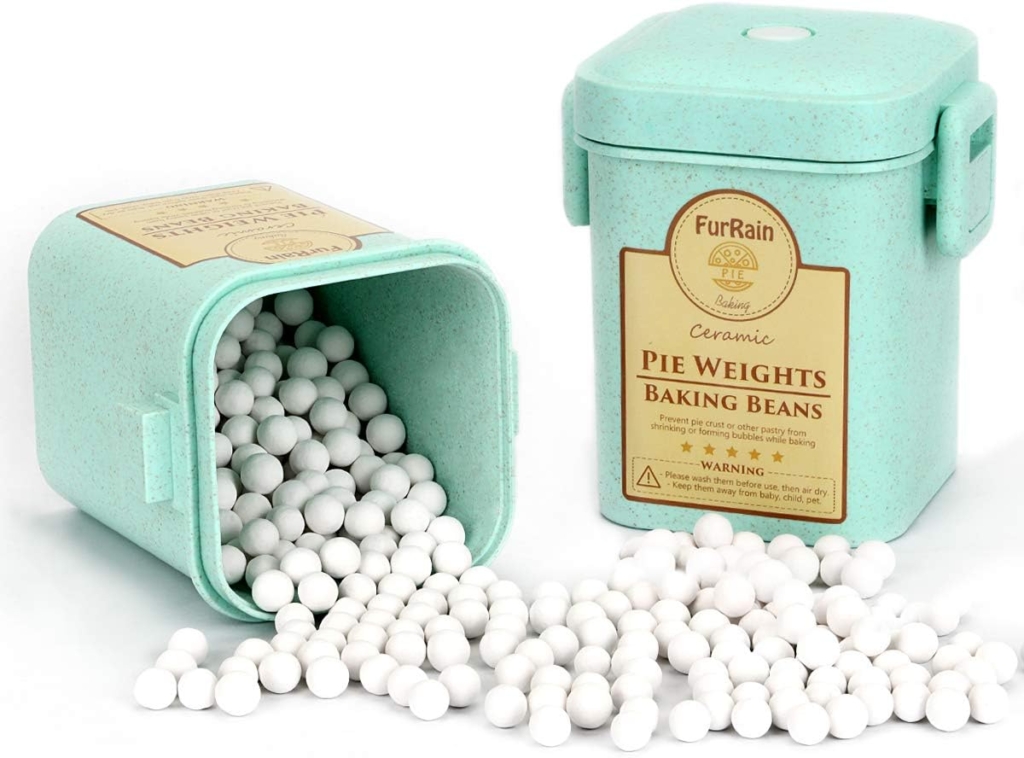
- Transfer the pastry to the lined sheet. Prick the entire surface with a fork to let steam escape. Lay the second sheet of parchment over the pastry, then the second baking sheet filled with pie weights or dried beans on top.
- Bake 20 minutes with the sheet and weights. Remove from the oven, carefully lift off the top sheet and parchment. Return the uncovered pastry to the oven for 12 to 15 minutes, until deeply golden. Cool 20 minutes on the sheet, then transfer to a rack to cool completely.
- Finish the cream. With an electric mixer fitted with the whisk, beat the cold cream on medium-high until it holds medium peaks, about 3 minutes. Take the pastry cream from the fridge and loosen it on its own, with a whisk, in its bowl, until smooth and supple again. Then fold in the whipped cream with a spatula, in two or three additions. Do not use the mixer at this stage. Cover and refrigerate 1 to 4 hours.
- Cut the squares. With a large sharp knife, trim the edges of the cooled pastry, then cut it into 15 even squares (measure the long side and divide by 5, the short side by 3).
- Make the topping. In a small bowl, whisk the powdered sugar, milk and vanilla until the glaze is smooth. Melt the chocolate in the microwave in 20-second bursts, stirring between each, until smooth. It yields about 1/4 cup (60 ml) once melted. Transfer it to a squeeze bottle or a zip-top bag with a corner snipped off.
- Place 5 squares on a rack set over parchment paper. Spread vanilla glaze over one square. Before it sets, pipe 4 lines of melted chocolate across the top. With a toothpick, drag perpendicular lines through, alternating directions to create a chevron pattern, wiping the toothpick between each pass. Repeat with the other 4 squares.
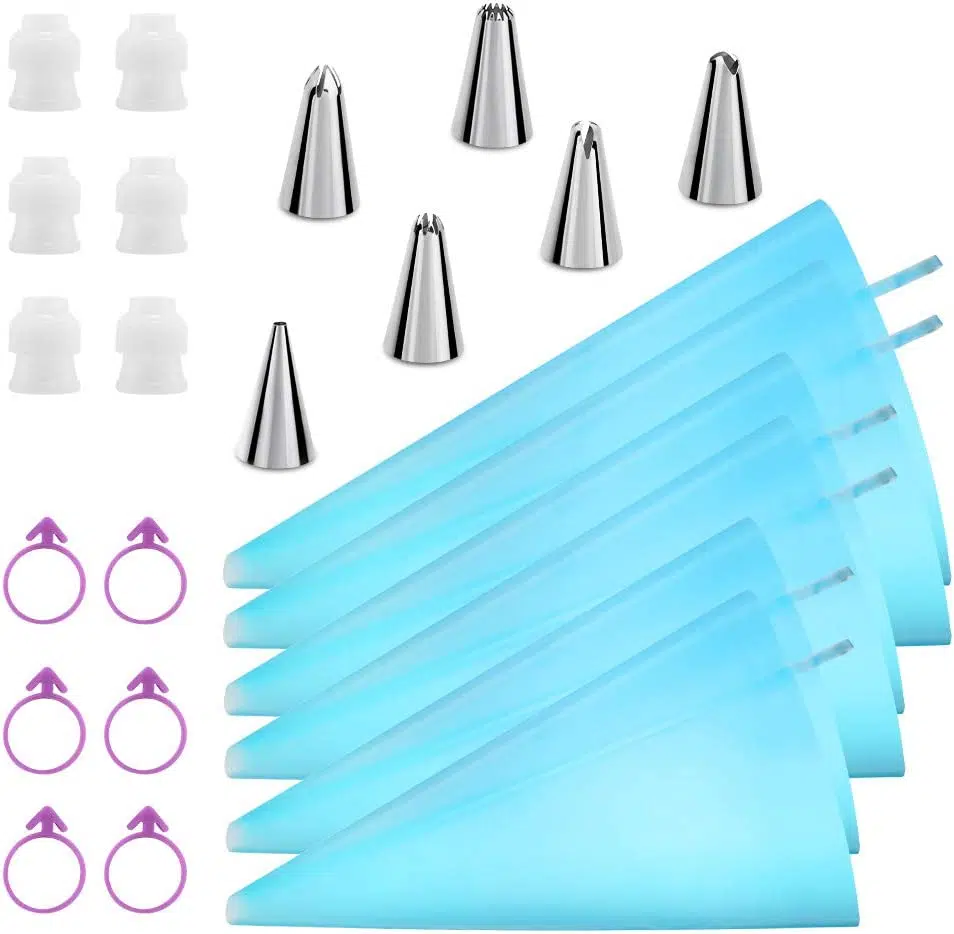
- Assemble. Fit a piping bag with a large round tip, or use a bag with the corner snipped. Starting with a plain square, pipe 9 domes of cream in 3 rows. Set a second plain square on top, pressing very lightly. Pipe another 9 domes of cream. Cap with a glazed square. Repeat to make 5 mille-feuilles.
- Refrigerate uncovered at least 30 minutes before serving, up to 8 hours.
Three things: puff pastry baked flat until crisp, vanilla pastry cream lightened with whipped cream, and a glaze on top. That’s it. The name means a thousand leaves in French, referring to the layers of puff pastry that separate as they bake. Everything else, including the chocolate chevrons, is decoration.
They’re the same dessert. Napoleon is the name used in North America and English-speaking countries, mille-feuille is the French original. One caution: the Russian cake also called Napoleon is a different thing entirely, built with buttercream rather than pastry cream.
Roughly meel-FOY, with the second part close to the word foil. The double L in French is silent here. If you say it the way it’s spelled, meel-FEW-ee, French speakers will still know what you mean.
Less than its reputation suggests, especially with store-bought puff pastry. The pastry bakes flat between two sheet pans, which removes all the guesswork. The one genuinely technical step is folding the whipped cream into the pastry cream, and even that comes down to loosening the pastry cream first and folding with a spatula.
Almost always because the pastry cream’s gel was broken while folding in the whipped cream. Cold pastry cream is set solid, and beating it to combine destroys the structure that holds everything up. Loosen it on its own with a whisk first, then fold with a spatula. If it still runs, add a tablespoon of cornstarch next time.
Eight hours maximum, with at least 30 minutes of refrigeration before serving. Past eight hours the cream starts softening the pastry from the inside and you lose the crispness that makes this dessert worth making. If you’re entertaining, prep every element ahead and assemble just before guests arrive.
Ads
Ads
Ads
Ads
Ads